

One of the key skills in reading pro vs amateur chart patterns is understanding whether the professionals are adding to positions or getting out - and this video shows you exactly how to do that in real time.
This video was sparked by a great question from Lloyd about Wednesday’s “Last Roll of the Dice” Short signal:
Hello Barry, How do we know whether the Pro bars at highs are initiating shorts or closing longs? One is bearish and the other is neutral until they re-enter the market. Does the indicator have the ability to distinguish that somehow? Thank you.
lloyd
The video is a little long - but comprehensive, I hope, in explaining how to identify what the Professionals and Amateurs are doing.
Professionals buy Low and sell High
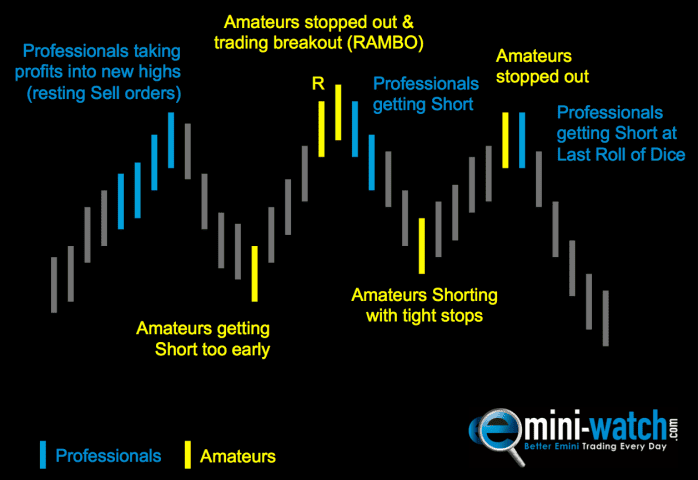
Better Pro Am uses average trade size to identify Professional and Amateur activity. It then paints Professional bars blue and Amateur bars yellow.
Professionals are moving large positions and it takes them time to accumulate and distribute these positions. Therefore, they tend to trade early into pre-determined price ranges. In general you will see Professionals:
- Buying new Lows with resting Buy orders
- Getting an uptrend going with “Jumping the Creek”
- After the downtrend has reversed, buying any dips
- Selling new Highs with resting Sell orders
- Getting an downtrend going with “Falling through the Ice”, and
- After the uptrend has reversed, selling any rallies
By contrast Amateurs are more reactive in their trading - they don’t have a pre-set plan. And they end up chasing price; selling Low and buying High. You will see Amateurs:
- Selling new Lows with RAMBO patterns signalling
- After the downtrend has reversed, selling any dips
- Buying new Highs with RAMBO patterns signalling, and
- After the uptrend has reversed, buying any rallies
One of the cleanest examples of Pros trapping amateurs is the Killing Fields chart pattern - pure professional positioning while retail piles in the wrong direction.
Always remember to wait to see what happens after a Professional bar prints - confirmation is key. And lastly, ignore Professional bars at the Open and Close - they don’t give much directional information.
Reader comments on ‘Are Professionals Buying or Selling?’
Barry, I just wanted to thank you for your last video explaining the Pro/Amateur bars. I have followed you for years and that was BY FAR the most informative one you have ever done IMHO. Fabulous video - Thanks for sharing 🙂
donovan w.